

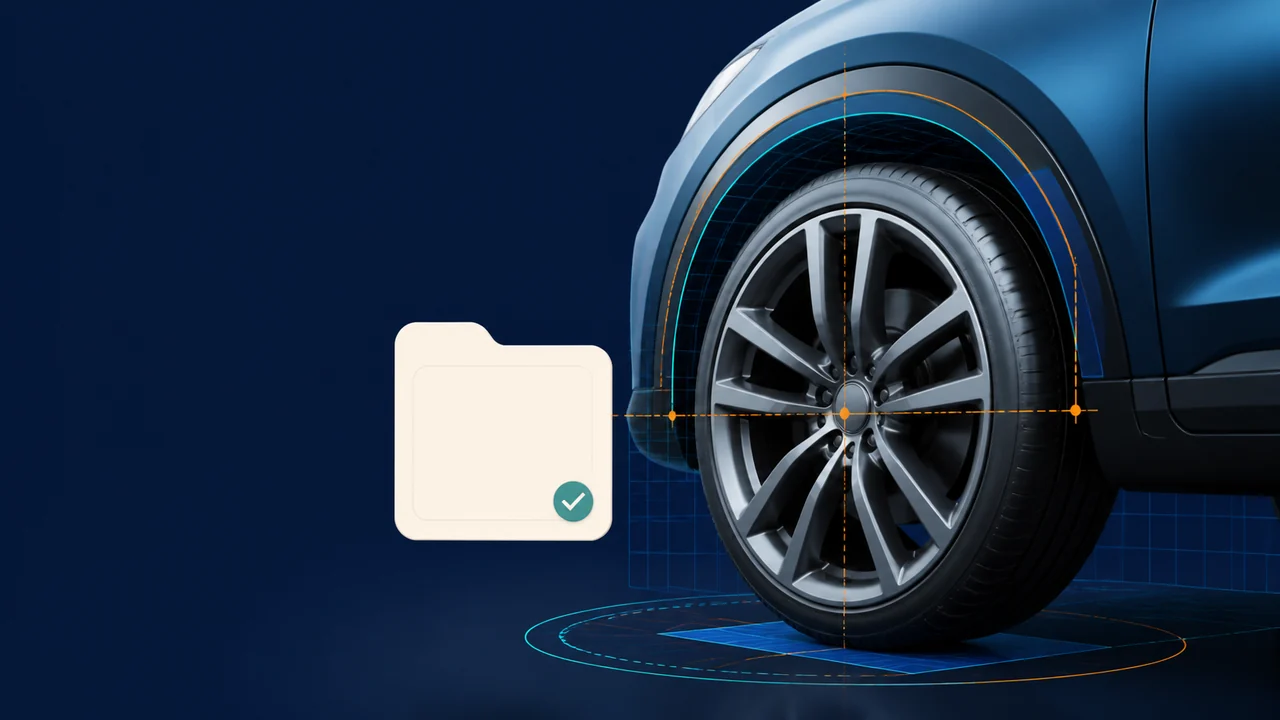
Check the size as a complete approved combination
- 1Vehicle specificationVIN, model year, engine and version.
- 2Approved combinationCoC, manual or official manufacturer information.
- 3Rim and sizeDiameter, width, offset and front/rear wheel combination.
- 4Service ratingsLoad, speed, XL and other required markings.
The calculator compares geometry but does not confirm car fit. First check CoC or official information by VIN, then rim, size and indexes.
Source: Regulation (EU) 2020/683, CoC form; checked 2026-08-07.
Where to find the allowed size
| Source | What to check | How to assess it |
|---|---|---|
| Certificate of Conformity (CoC) | The tyre/rim combination for the exact version; item 35 in the current EU form, with extra variants possibly in remarks | The main reference for the individual vehicle |
| Manufacturer's manual or official VIN-specific information | Approved alternative sizes, load and speed requirements, and front/rear combinations | Use for the exact version, engine and specification |
| Tyre pressure sticker | Manufacturer's pressure and, where given, sizes for the load | Useful confirmation, but an incomplete sticker is not the complete list of approved combinations |
| Currently fitted tyre | Only a clue to where the search should start | Not proof: a previous owner may have chosen incorrectly |
| Online size calculator | An indication of outer diameter and speedometer changes | A geometry filter, not vehicle manufacturer approval |
In the CoC form under Commission Implementing Regulation (EU) 2020/683, item 35 concerns the fitted tyre and rim combination; further details may appear in the remarks. Numbering can differ in older documents or other vehicle categories, so find the combination rather than relying only on “35”. If the CoC is missing or unclear, ask the manufacturer using the VIN instead of relying on a generic online list.
What does 205/55 R16 91V XL mean
- 205 is the nominal width of the tyre in millimeters.
- 55 - Profile height equal to 55 percent of nominal width.
- R is the radial design and 16 is the rim diameter in inches.
- 91 - load index to be converted to permissible mass according to the official index table and compared with the car requirement.
- V – speed category; it must meet the requirement for the specific version and cannot be selected based on normal driving speed alone.
- XL is a reinforced, heavy-duty tyre designation. It does not make an unconfirmed size valid and does not replace the required load index check.
We explain all sidewall markings in more detail in a separate tyre marking guide. The most important thing in this step is to treat the whole row as a single specification: the same 205/55 R16 size with a different load or speed index is not automatically an equivalent choice.
Six steps to the right combination
- Identify the car by VIN, model year, engine and exact version. The brakes, mass or homologation of the same model may differ.
- Find the approved tyre and rim combination in the CoC document or manufacturer's official information. If the front and rear axle sizes are different, keep the indicated location.
- Check the rim: diameter, width, offset and other parameters of the manufacturer's combination. Just because a tyre can be physically put on doesn't mean it's suitable for a car.
- Check the load index according to the manufacturer's requirement and the technically permissible mass of the respective axle. Do not divide the car's mass by four - the axles are loaded unequally, and the maximum technically permissible axle mass is applied during homologation.
- Check the speed category according to the manufacturer's instructions and the maximum design speed of the car. Winter tyres may be subject to a regulatory exemption with minimum limits and a visible warning to the driver, so do not apply them arbitrarily.
- Only after checking the size and indexes, choose the season, independent test result, EU label, price and other usage priorities.
Is it possible to choose an alternative size?
Yes, if an alternative combination of tyre and rim is provided for a specific car version in the CoC, in the manufacturer's documentation or authorized by the applicable technical procedure. Close outer diameter does not in itself confirm fit: rim width and offset, clearances to suspension or brakes, load and speed capabilities, speedometer reading and permitted axle combinations may vary.
What Lithuanian technical requirements check
The current edition of the Lithuanian technical requirements links the size and construction of the wheels to the vehicle manufacturer's design and requires the compatibility of the rim and tyre parameters. The wheels on the same axle must match, and the tyres must be of the same construction type, same size marking and purpose. This is another reason not to evaluate a single tyre in isolation from the car, rim and axle pair.
Common mistakes
- Copying the now fitted size without checking if it was correct at all.
- Consider the approximate diameter shown by the calculator as permission to install another size.
- Assuming that a higher load or speed index compensates for the wrong size or rim.
- Go for XL just because of the stronger name without checking all the approved specs and required pressure.
- Mix tyres of different sizes, designs or uses on the same axle.
- Search only by car model, but ignore VIN, engine, model year and version.
Frequently asked questions
Can I buy the size currently fitted?
Only after checking the CoC or official manufacturer information for the exact vehicle version. The fitted tyre is a clue, not confirmation.
Is a higher load index always suitable?
A higher number alone is not enough. The tyre must still match an approved tyre/rim combination, with pressure and other conditions meeting manufacturer requirements.
Can I choose a lower speed rating?
Normally it must meet the manufacturer's requirement and the vehicle's design speed. Regulations allow a specific exception for some 3PMSF winter tyres with limits and a visible warning, so check the vehicle documentation rather than only a letter table.
Does XL mean a better tyre?
No. XL identifies a reinforced higher-load variant, not overall quality, comfort or suitability for your car. Check the complete approved specification.
What if the size I want is missing from the CoC?
Ask the manufacturer's representative using the VIN, or a qualified technical expert about the lawful approval process. An online calculator or retailer's catalogue cannot add approved combinations itself.